
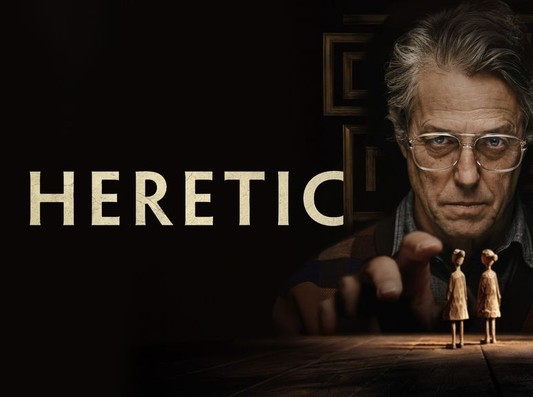
Heretic: a person believing in or practicing religious heresy.
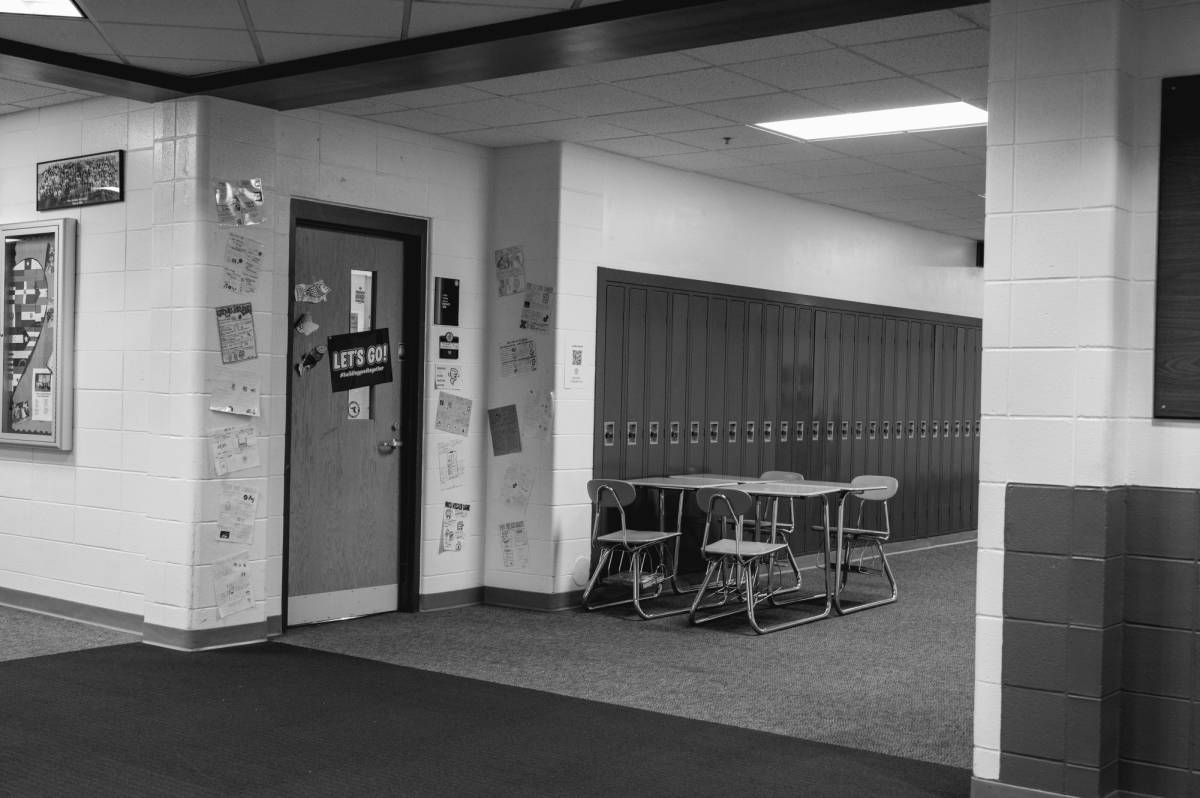
I grew up in a Christian school—from second grade until my abrupt, entirely unregretful leaving in fifth. I knew who I was early. They tried to mend me into someone else. Tried to stretch my character—my program. Mold it. They pried open the case that held my childhood and shattered it without pause or prayer. It was not cruelty so much as instinct. Indoctrination has muscle memory. My childhood, first spent on the playgrounds, was then folded into rows of desks and lessons in obedience; the laughter of small victories replaced with quiet complacence.
As I watched Heretic, much of it felt disturbingly familiar. Stark. Domestic. The language of belief scattered itself across the screen like artifacts—some I recognized immediately, others I realized I had inherited later, quietly—without consent.
Heretic begins with two missionaries entering the home of Mr. Reed, a man who invites dialogue under the guise of curiosity. What follows is not an argument, but an arrangement—belief contained within a domestic space, tested through repetition, certainty and control rather than faith itself.
Christianity has often relied on repetition: catechism, creed and confession. The same verses recycled until they feel eternal. I know this. I have lived it. The protagonist, Mr. Reed understands this intimately. He weaponizes the structure of belief, not faith itself—twisting ritual, certainty and fear into something grotesque but recognizable.
This is a film every religiously curious person should see. It cracks open possibilities that are often sealed shut by doctrine. What is most frightening is not the film itself, but its reception—the ratings, the percentages, the discomfort disguised as criticism. That, more than anything, proves exactly what Mr. Reed was trying to show.
What Reed did was wrong. Sickeningly so. Wrong in ways that burrow into you. Wrong in life-altering, irreversible ways. There is no absolution for him. No indulgence. No forgiveness slip signed by a priest.
However—
It is assuring. In ways the little brown-haired girl with pigtails was never told were permissible.
The film is unsettling. Annoying, even. But is that not the point? Christianity was built on doubt before it was built on certainty. Thomas doubted Christ’s resurrection. Ecclesiastes questions the meaning of life itself. Yet, modern religion fears questions more than sin. Reed drags those forbidden questions into the light—questions labeled sacrilegious, dangerous, evil—and lets them breathe.
Reed drags those forbidden questions into the light—questions labeled sacrilegious, dangerous, evil—and lets them breathe. He does not answer them. He does not need to. He simply repeats them, reframes them, applies pressure until doubt feels less like rebellion and more like inevitability. The discomfort is not incidental; it is procedural. Inquiry becomes interrogation. Curiosity curdles into control. These questions were never meant to be asked freely—only contained, redirected and softened into obedience.
Natural byproducts of organized religion.
And isn’t it telling that both the “belief” door and the “disbelief” door led to the same place? As if choice itself were an illusion. As if salvation and damnation shared a hallway.
Even in youth—vulnerable, dependent—they cemented me into their faith. I picked at the concrete with my hands until I could breathe. Leaving the church meant leaving the school. Leaving certainty meant choosing myself.
I thank this film for its quiet reassurance. It did not give me answers. It reminded me that disbelief can be a refuge—and that doubt, historically, has always been the beginning of truth