
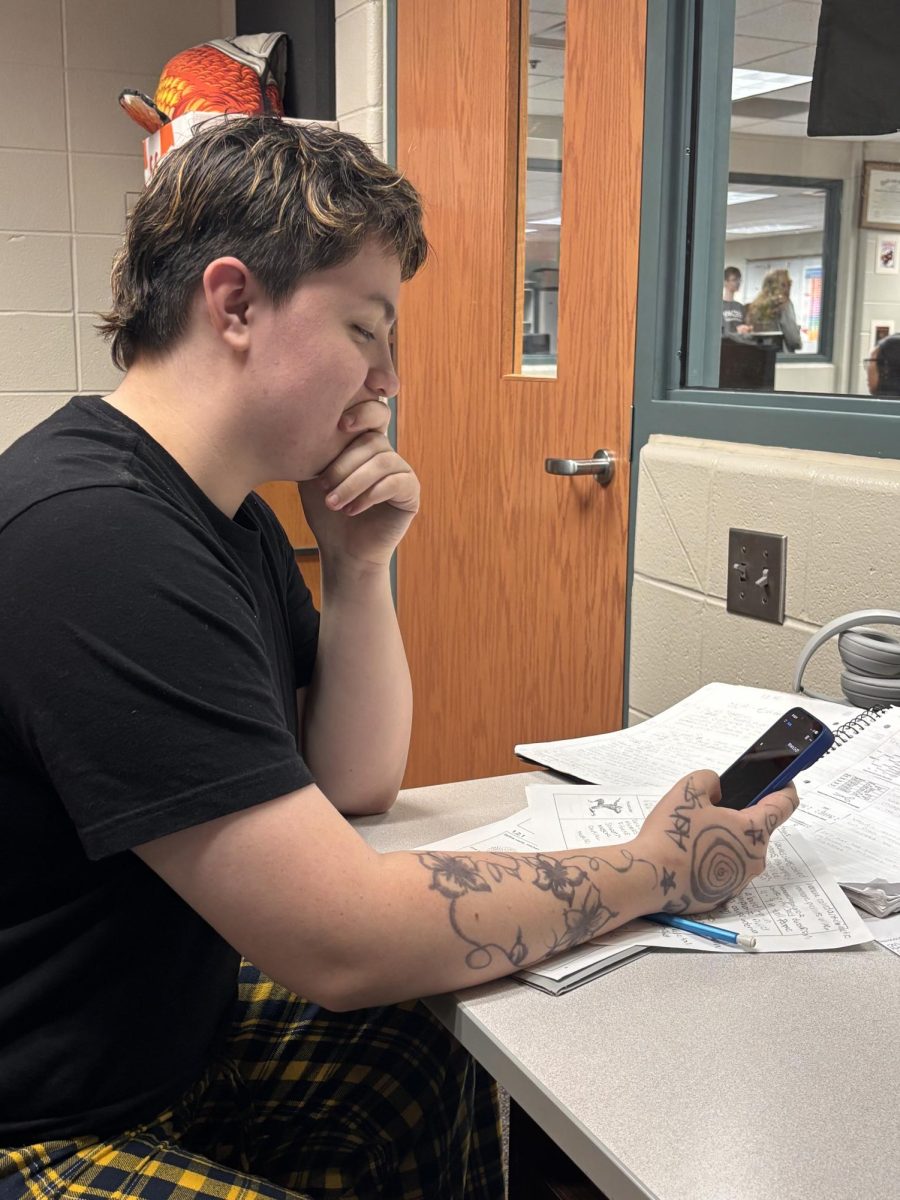
Effective July 1, 2026, Senate Bill 78 states that all non-school issued, wireless communication devices will be prohibited from use from the first bell to the last. This includes cell phones, smart watches, smart glasses, etc. The bill offers two options of executing the law: keeping devices off school campuses in entirety, or leaving them in a “secure and inaccessible” place throughout the school day. For Perry Meridian High School, Principal Kurt Boedicker has decided to implement the second option.
With the transition of completely cutting out phones from school, some things in Perry Meridian are planning to change for the 2026-2027 school year. Many media students are being provided school-issued devices to replace the use of phones when it comes to interviews, such as tape recorders and more school-issued cameras. This has been a frustration within the media empire, as the restriction on phones decreases efficiency for fast-paced media creation. “It’s going to be harder to transfer direct quotes. It’ll just make it [take] more steps, which will, in turn, harm the efficiency of our process,” junior and media student Abrielle Blackwell said. With being in Creative Writing Club, the year book team and broadcasting for Falcon TV, Blackwell believes having phones in school is a “superpower,” as many aspects of recording, photographing, writing and editing can be easily completed on a phone versus other devices.
With the lack of student’s communication devices, many are worried that the new law can be problematic when it comes to safety protocols. Through a handful of threats that have been involved with Perry Meridian, students are afraid that they will not be able to contact parents in the case of an emergency. “We see schools all over the country, especially in the United States, getting school shooters from either outside forces or people inside the school, which is very threatening. I think it’s very scary to a lot of students,” junior Violet Jennings said. To ease the anxiety within students regarding safety, Boedicker has implemented the idea of trust, which he believes sprouts from 2 ideas: “your words and your actions,” Boedicker said. “Student safety is the top priority here at Perry Meridian.” And through these principals, Boedicker ensures that students will be able to contact parents and family through teacher or admin phones in case of emergency.
With the ease of some individuals’ minds, many believe that this transition will sprout a “pre-COVID energy that we had at school,” Blackwell said. Instead of eating lunch with a phone in hand, students are going to communicate with friends to rid themselves of boredom. This will bring a larger sense of community between students who would normally endlessly scroll social media. Teachers are also happy with the decrease in opportunities to cheat on tests and assignments. “I think it really takes away from the aspect of learning, because people just go to Google or AI [for answers]. Their phones also have social media, […] so there’s also that distraction aspect which, if taken away, would be good,” Nathalia Gumiran said. Many students will have a decreased distraction from social media, which can also decrease stress levels and increase attention span. Social media being a quick, instant dopamine hit is what causes children to become addicted so easily. With this distractor being taken away, many students will have to find other things to entertain themselves during school hours next year.